


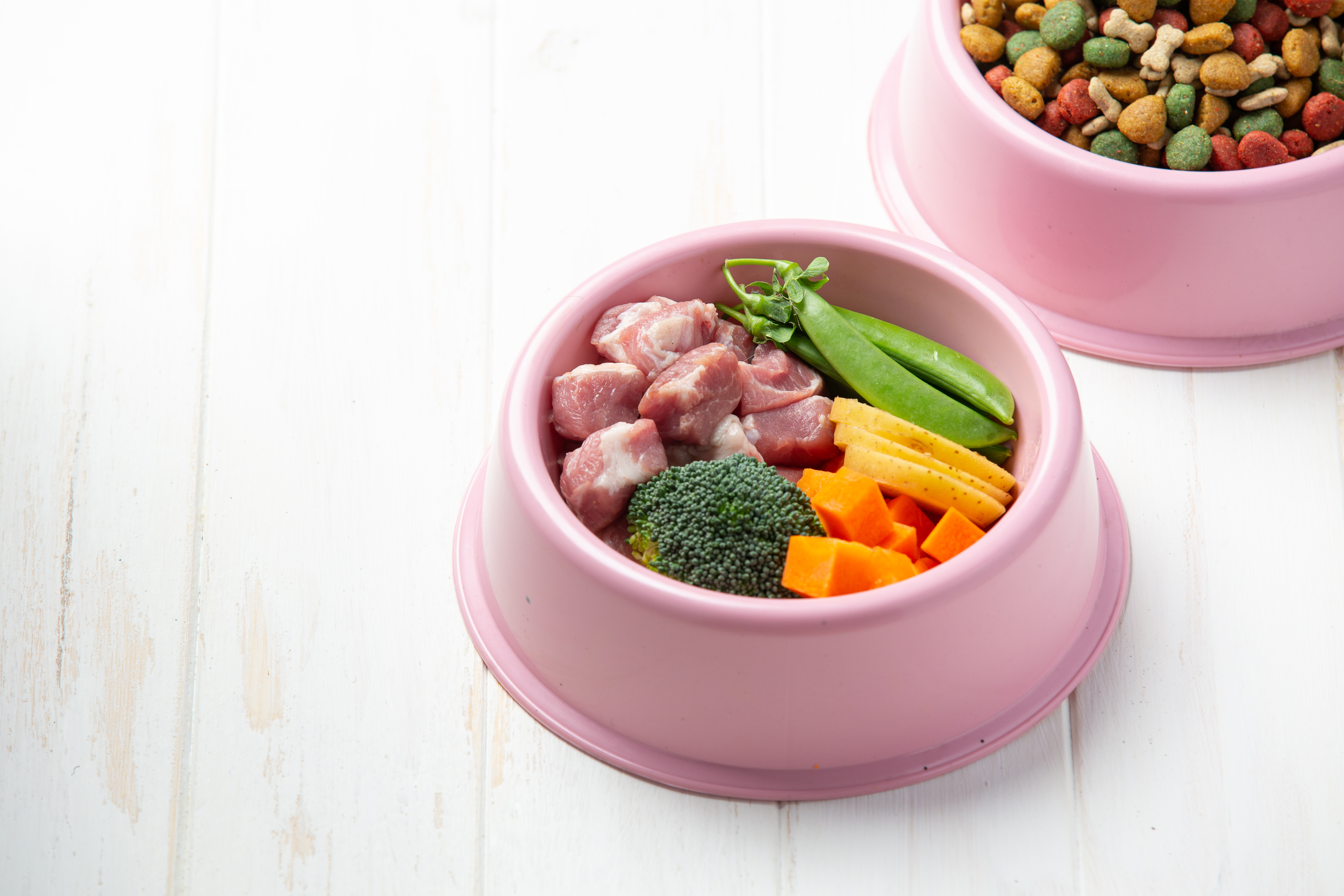
If chicken tops your dog’s food ingredient list, it can feel like an easy win. But fresh chicken and chicken meal bring very different amounts of water to the recipe, so their positions on the label don’t tell the whole story. Understanding that difference makes it easier to compare foods without assuming “fresh” automatically means better.
Fresh chicken vs. chicken meal: why order can mislead
In the U.S., pet food ingredients are listed from greatest to least by weight. That order reflects the ingredients as they go into the recipe; it doesn’t show how much of each ingredient remains in the finished food or how much protein it supplies. The Association of American Feed Control Officials (AAFCO) explains that ingredient order doesn’t quantify the amount of each ingredient. AAFCO is a membership organization whose model rules are used by state feed regulators; it is not a federal agency.
Fresh chicken contains substantial water. Chicken meal has already been cooked and rendered, a process that removes much of its water and fat. So a pound of fresh chicken may weigh more going into the recipe, while a smaller weight of meal can contribute more concentrated dry material. If fresh chicken appears first on a kibble label, that alone doesn’t tell you whether chicken supplies most of the finished food’s protein.
Think of the ingredient list as a snapshot of recipe inputs, not a finished-food nutrition report. It can help you see which ingredients are used and in what order, but it cannot answer how much chicken is in the bowl after processing.
Water changes the math before cooking
Imagine a recipe starts with 10 pounds of fresh chicken and 8 pounds of chicken meal. The chicken may appear first because it weighs more when added. But fresh chicken’s water largely leaves during cooking, while meal already has much of its water removed. You cannot use those starting weights alone to calculate how much chicken protein ends up in the kibble. The example is hypothetical; actual moisture and nutrient contributions vary by ingredient and recipe.
Moisture also makes the guaranteed analysis harder to compare at a glance. A dry food and a refrigerated food can show different protein percentages partly because one contains much more water. For a fairer comparison, look at nutrient levels on a dry-matter basis, which removes water from the calculation. If a food’s package doesn’t provide dry-matter figures, the manufacturer may be able to provide a typical nutrient analysis. A veterinarian or veterinary nutritionist can help interpret it for a pet with specific needs.
For example, if Food A is 10% moisture and 25% protein as fed, its dry matter is 90%. Divide 25 by 90 and multiply by 100: the protein level is about 27.8% on a dry-matter basis. If Food B is 70% moisture and 9% protein as fed, its dry matter is 30%; 9 divided by 30, multiplied by 100, is 30%. The as-fed numbers look far apart, while the dry-matter figures are closer. These calculations compare nutrient concentration, not the amount of protein a pet gets per day; calorie intake and serving size matter too.
What “meal” means on a U.S. pet food label
In pet food, “meal” doesn’t simply mean dried pieces of fresh meat. Under AAFCO’s ingredient definitions, poultry meal is a rendered product made from poultry flesh and skin, with or without bone, and excludes feathers, heads, feet and entrails. Rendering cooks the material and removes much of its water and fat. “Chicken meal” names a particular bird species; “poultry meal” may refer to a combination of poultry species.
That distinction can help when you’re checking a label for a known food sensitivity or simply want to know which animal ingredients are included. A named ingredient does not, by itself, reveal its nutritional quality or the exact proportions used. AAFCO also distinguishes poultry meal from poultry by-product meal; those terms have different definitions. The AAFCO ingredient guide explains what the terms mean. A word like “meal” alone isn’t a verdict on whether a food is suitable.
Fresh and rendered ingredients are processed differently
Processing is not a single switch that turns nutrition “on” or “off.” Fresh chicken added to a cooked or refrigerated food and rendered chicken meal added to kibble follow different paths, and the final diet depends on the full recipe and manufacturing process. Heat can change some nutrients, while cooking also makes food safe and can affect how nutrients are digested. A label’s ingredient order cannot show those effects.
Research in dogs gives useful context, though it doesn’t establish a universal winner. In a 2021 preliminary feeding study, researchers compared one chicken-based extruded kibble with fresh diets in separate groups of healthy, normal-weight Beagles over 10 days. They reported higher apparent digestibility for several nutrients in the fresh diets. But the diets differed in fiber and other recipe characteristics, the trial was short, and the results don’t show that fresh chicken itself caused the difference or predict long-term health outcomes for every dog. Read the study by Hall et al. (2021).
A later study by Bullen et al. (2024) fed ten adult Beagles several commercial diets, including fresh, extruded and raw formats. The authors found differences in digestibility, but the foods varied in ingredients and processing, making it difficult to credit those differences to one ingredient or format alone. Both studies concern dogs; they do not establish the same effects in cats, whose nutrient needs differ.
Compare the complete food, not a single ingredient
When you’re deciding between foods, start with the nutritional adequacy statement. In the U.S., look for a statement that the food is complete and balanced for your pet’s species and life stage, and check whether that claim is based on meeting nutrient profiles or on feeding tests. AAFCO describes these options in its label guide. The statement is more relevant to whether a food is intended as a main diet than whether chicken appears first.
Next, compare calories per serving, feeding directions and the guaranteed analysis in light of your pet’s age, body condition and health. Ingredient lists can help you identify named animal proteins or ingredients your pet needs to avoid, but the order isn’t a scorecard for quality. If your pet has a medical condition, a history of food reactions or a prescribed diet, ask your veterinarian before switching.
Fresh foods may suit households that prefer a refrigerated or frozen format, while dry foods can be easier to store and serve. The choice also affects cost, storage and portioning. If you’re sorting through labels, APPETTO offers a place to explore pet food information; use product details alongside your veterinarian’s advice for your individual pet.
A practical way to read the chicken claim
When “fresh chicken” catches your eye, check what comes next on the ingredient list and look at the food’s complete nutritional information. When you see chicken meal, remember that it is a more concentrated rendered ingredient, not a direct measure of how much protein the finished food provides. Compare foods on a dry-matter basis when moisture differs, and keep calories and nutritional adequacy in view.
There’s no need to treat fresh chicken as a guarantee or chicken meal as a warning sign. The most useful question is whether the finished food is appropriate for your pet and whether its nutrition, portion and format work for your household. For another label-reading comparison, you can browse APPETTO.
Frequently asked questions
Does fresh chicken at the top of the list mean chicken is the main protein?
Not necessarily. Ingredient order reflects weight when ingredients are added, and fresh chicken contains water that is largely lost during cooking. The list does not quantify how much protein each ingredient contributes to the final food.
Is chicken meal the same as dehydrated chicken?
Not always. In U.S. pet food labeling, chicken meal is a rendered ingredient with a defined composition. “Dehydrated chicken” may describe a different ingredient or process, so check the label’s exact wording and ask the manufacturer if you need clarification.
Is fresh chicken food always more digestible than kibble?
No single result applies to every recipe or pet. Small dog studies have found digestibility differences between some fresh and extruded diets, but ingredients, fiber, cooking and other formulation details also vary. Those studies don’t prove that fresh chicken alone improves health.