


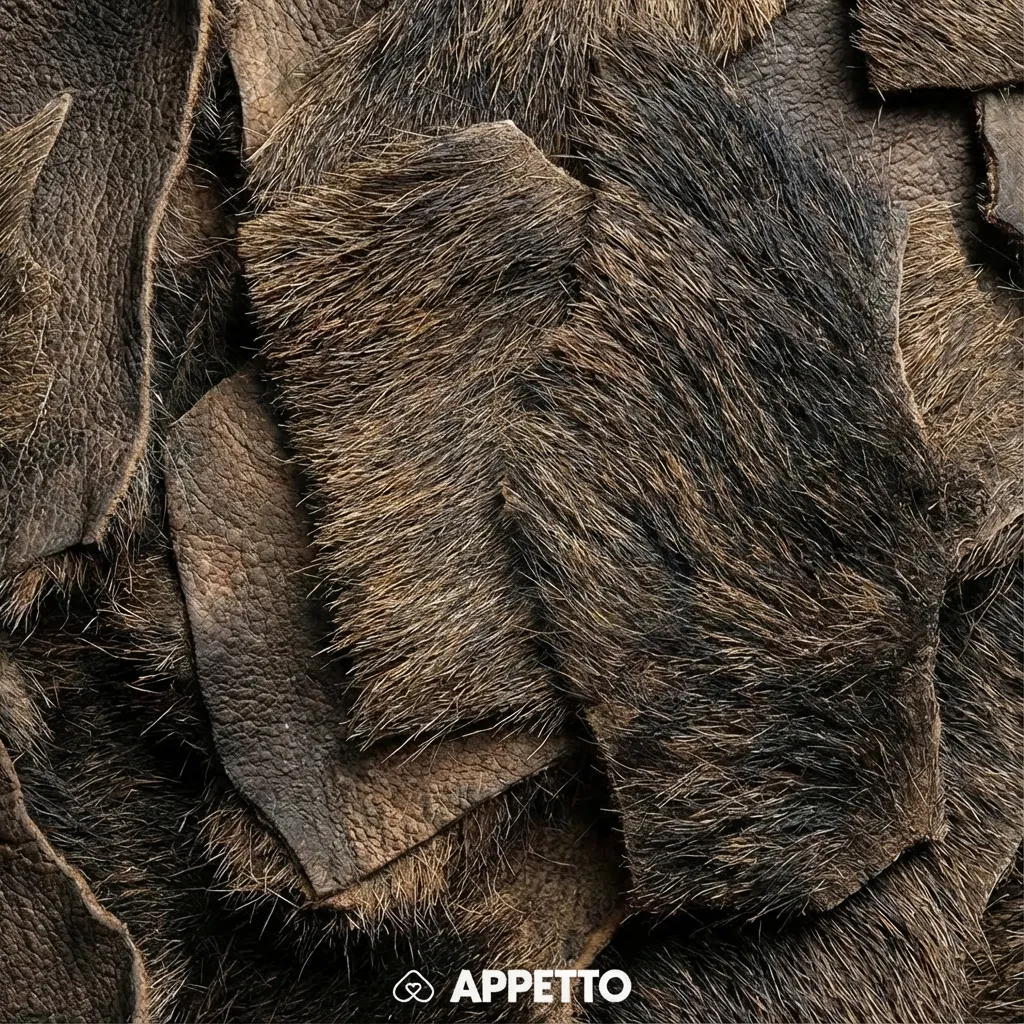
Wild boar skin can be offered to dogs in moderation only when prepared as an appropriate chew treat, in small pieces, and under supervision. Raw, thick, or given in large strips, it becomes risky. Yes, even if your dog clearly thinks they are a wolf from a nature documentary.
Quick Verdict
- For dogs: allowed in moderation.
- Key takeaway: favor small dried strips without additives, never large raw strips.
Wild boar skin for dogs: allowed, limited, or forbidden?
Wild boar skin is sometimes available as a chew treat. It should remain an occasional snack, adapted to the dog’s size, and supervised. The origin, preparation, and texture matter a lot.
Is wild boar skin dangerous or toxic for dogs?
It is not toxic in itself, but it can be mechanically dangerous. Thick, hard skin or long strips that are swallowed whole can cause choking or intestinal blockage. In its raw state, health uncertainties related to wild game justify caution.
What are the potential benefits?
The benefits mainly revolve around chewing and keeping the dog occupied.
- Stimulates chewing.
- Provides occasional occupation under supervision.
- Offers a limited, secondary source of protein.
What are the risks to know?
The format is often more important than the food itself.
- Choking if the piece is too big.
- Blockage if a hard strip is swallowed whole.
- Diarrhea in case of excess.
- Parts to avoid: large thick raw strips, hard pieces, and salted, smoked, or seasoned products.
How much should you give your dog?
Wild boar skin should remain an occasional treat, not a regular food. It must be taken away if it becomes too small, too soft, or easy to swallow.
- Small dog: small adapted piece, under strict supervision.
- Medium dog: small chew treat, occasionally.
- Large dog: piece adapted to their size, without letting them swallow large strips.
Can my dog eat raw, cooked, or dried wild boar skin?
The dried form, controlled and without additives, is the most common, but it does not eliminate all risks. Raw skin should be avoided due to sanitary precautions. Salted, smoked, or spicy skins are not suitable.
How to prepare it properly?
- Choose a product intended for dogs, without salt or unnecessary additives.
- Give it under supervision and adapt the size to the dog.
- Remove the piece if it becomes too small or fragments.
When should it be avoided?
- In puppies.
- In senior dogs with fragile teeth.
- In greedy eaters or dogs prone to blockages.
- In dogs with digestive issues or on a veterinary diet.
My dog ate wild boar skin: what should I do?
If the quantity was small and the product suitable, just monitor them. If your dog swallowed a large strip, a hard piece, or raw skin, contact a vet, especially in case of discomfort or digestive issues.
What signs should alert you?
Coughing, choking, vomiting, diarrhea, constipation, abdominal pain, lethargy, or refusal to eat should prompt concern.
What are safer alternatives?
- Chew treats adapted to the dog’s size.
- Dental chews approved for dogs.
- Durable chew toys under supervision.
How can APPETTO help you?
APPETTO helps you compare chew treats and better understand their true value thanks to the Pet-Score®, without being guided solely by labels or marketing. Download APPETTO.
FAQ
Is wild boar skin dangerous for my dog?
It can be if it is raw, too hard, too large, or swallowed in strips.
How much wild boar skin can I give my dog?
A small occasional treat adapted to their size, always under supervision.
Can my dog eat raw wild boar skin?
It is better to avoid it due to sanitary uncertainties.
Can my dog eat dried wild boar skin?
Yes, with caution, if the product is meant for dogs, additive-free, and given under supervision.
What signs should I watch for after ingestion?
Coughing, vomiting, diarrhea, constipation, pain, or lethargy.
Can a puppy eat wild boar skin?
It is best avoided, as the risk of choking or blockage is higher.
Wild boar skin can be tolerated by dogs in a suitable form, but it requires supervision and moderation. To compare treats with more clarity, APPETTO helps you using the Pet-Score®. Download APPETTO.
Credits and disclaimer
Credits: Content created by the APPETTO team based on referenced sources and our internal food classification methodology.
Disclaimer: This information is general and does not replace veterinary advice.